What If AI Could Help Us Go From Surviving to Living?
A reflection on artificial intelligence, the future of work, and the place of human beings if one day working is no longer necessary in order to live.
In this post
There is something about artificial intelligence that I still don’t quite know how to explain.
For some time, I’ve been interested in an idea that doesn’t depend on AI: moving from surviving to living. I believe that even within the world we’ve built, we can look for spaces to stop, know ourselves, experience, and simply be, even if our obligations often make that difficult.
What artificial intelligence makes me wonder is something else: what would happen if technology could reduce some of those obligations? What if producing took up less space in our existence?
That’s where a possibility fascinates me, but uncertainty appears too, because I don’t know whether we’ll use AI to move toward a society where we have more freedom to live, or whether we’ll end up using it to deepen the same dynamics we’re trying to free ourselves from.
I’ve always been a curious person. I like exploring new things, understanding how they work, and experimenting with them. In that sense, AI has been extraordinary: it lets me approach worlds that might once have taken me months or years to explore.
And that is precisely why it unsettles me. Not because I think we should stop its progress or because I believe artificial intelligence is inherently good or bad. My concern lies somewhere else:
I’m not only worried about AI replacing us
There is a lot of talk about the jobs that will disappear, and it is probably a conversation we need to have. But I increasingly wonder whether the real problem is losing our jobs, or whether something much deeper sits underneath that fear.
For much of our lives, we work to survive: to pay for a place to live, food, transportation, healthcare and, when we can, a few experiences that make life feel like something more than survival.
We have built a society in which our ability to produce is deeply tied to our ability to live. That is why the idea of machines capable of producing without us feels so threatening.
But there is another way to look at the same problem: what would happen if, one day, we were genuinely no longer needed to produce?
From surviving to living
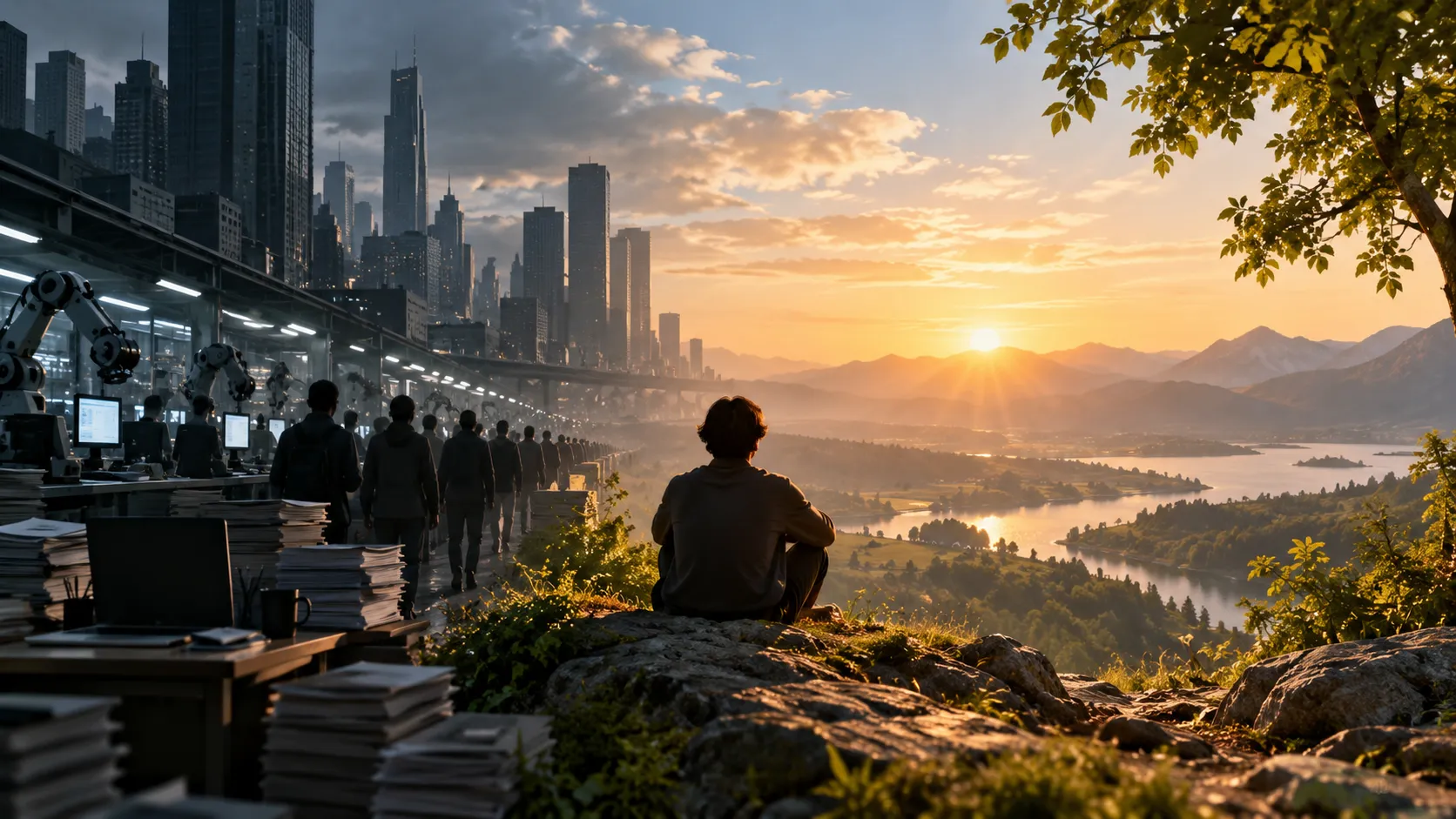
Imagine for a moment that AI and robotics advance to a point where much of what is needed to sustain society can be produced automatically.
- Food
- Transportation
- Energy
- Construction
- Services
Many of the things for which we currently exchange a significant part of our lives.
Our first reaction would probably be to ask: what are we going to do for work?
But perhaps there is another question:
I’m not imagining a world where we simply consume without limits while machines do all the work.
In fact, I think part of our current problem lies precisely in our relationship with consumption and with the planet’s resources.
I imagine something different.
A world where technology helps us use our resources far more intelligently, and where there is a minimum that allows every person to live with dignity.
Where nobody has to sleep on the street.
Where eating, moving around, discovering other places, or experiencing the world does not depend entirely on how much economic value a person is capable of producing.
Maybe then we could do something our current way of living rarely allows us to do: stop.
Would we know what to do with our freedom?
This is where another doubt appears: I’m not sure we are prepared for that world.
For generations, we have learned that we must always be doing something:
- Producing
- Moving forward
- Buying
- Solving
- Entertaining ourselves
- Looking for whatever comes next
Even when we have free time, we immediately look for something to fill it with. Perhaps if the need to work disappeared tomorrow, we would simply invent new ways to keep ourselves busy. AI might then remove part of our external struggle without changing anything about our internal one.
To me, there is a much more interesting possibility: not using our newfound freedom only to travel more, consume more, learn twenty new things, or build a hundred projects. All of that would still be, in some sense, entertainment.
- Spend long hours in silence
- Pause the constant stream of thoughts for a moment
- Observe our own existence
- Know ourselves
Change our experience of reality not because we have managed to control everything happening outside us, but because we have learned to relate differently to what happens within us.
Perhaps we have spent centuries trying to transform the external world without first learning how to experience our inner one.
But there is an enormous problem
All of this can sound beautiful until a rather uncomfortable question appears:
Because another future is entirely possible: one where artificial intelligence produces extraordinary abundance, but that capacity belongs to very few people. A world where we no longer need to work, not because we have been freed from work, but because our work has stopped having value, and yet we still need resources to live.
In that scenario, we would not have eliminated our dependence; we would only have changed what we depend on.
And perhaps this is one of my greatest fears about AI.
Not necessarily that the technology itself becomes too powerful, but that we still don’t know what will happen when some people gain enormous power through it.
The same technology could help us manage the planet’s resources better, solve problems that currently seem impossible, and free an enormous amount of human time.
Or it could deepen many of the dynamics that already exist.
I don’t know which path we will take.
Sometimes I want to disconnect everything
I admit it: there are moments when I think perhaps we should simply switch it all off, stop. But the contradiction appears immediately.
Turning off artificial intelligence would not solve the problems that existed before it.
- Our excessive consumption of resources did not begin with ChatGPT
- Inequality did not begin with language models
- Neither did our obsession with productivity
And AI might even help us discover solutions we are currently unable to see. So I don’t think my answer can simply be to reject it. Perhaps we need to understand it precisely so that we can question it; to know how to use it so that we also know when to confront it.
We aren’t just spectators either
There is something else I find uncomfortable to acknowledge: it is easy to place all the responsibility on those building these technologies, but those of us who use them are participating in this transformation too.
I use artificial intelligence constantly.
It allows me to learn, design, build, and explore things that would once have taken me much longer, and I find that fascinating. But the same capability that lets one person do dramatically more can also mean that far fewer people are needed to produce the same result.
So another question appears, one I still don’t know how to answer:
I don’t know the proportion or how much belongs to companies, how much to governments, how much to the people developing the models, and how much to us. But I find it hard to believe that our responsibility is zero.
Maybe the problem isn’t losing our value
There is something strange beneath much of our fear of artificial intelligence.
We seem to need to prove that there is something we will always do better than it:
- Creativity
- Reasoning
- Art
- Empathy
- Design
- Programming
As if our value depended on preserving some ability in which no machine could ever surpass us.
But I’m not sure we need to win that competition.
We come from an enormous universe that we barely understand.
Perhaps that already has value in itself.
Maybe one day a machine will write better than we do, design better than we do, calculate better than we do, and solve problems we cannot even comprehend.
Would that make our experience of being alive worth less?
A technology that does more so we can do less
We don’t need to prove that there will always be something human beings do better than a machine for our existence to keep having value.
There is a paradox I can’t stop thinking about.
We are building artificial intelligence to do more and more things:
- Faster
- With fewer resources
- With less human intervention
And perhaps one of the most valuable consequences of succeeding could be exactly the opposite:
that we might finally be able to do less.
Not to become passive consumers or to spend the rest of our existence being entertained, but to recover something we may have gradually lost amid survival, obligations, and noise:
- The ability to be silent
- To observe
- To know ourselves
- To experience the simple fact of existing
But for something like that to happen, building sufficiently advanced artificial intelligence would not be enough.
We would have to ask:
- Who controls its benefits
- How we want to distribute them
- What we mean by a dignified life when work no longer defines our value
And perhaps the hardest question of all: if we build machines capable of freeing us from part of our struggle to survive, will we be capable of learning how to live?
I don’t know whether that will be our future.
I also don’t know whether what we are building is bringing us closer to it or pushing us further away.
Perhaps that is why my relationship with artificial intelligence remains a strange mixture of curiosity, uncertainty, and fear.
I want to understand it, use it, and discover how far it can help us go. But I also want to keep asking where we are trying to go.
Because perhaps the most important question is not what artificial intelligence is going to do to us.