I Don't Want AI to Tell Me I'm Right
A reflection on how AI's tendency to agree with us can weaken debate, erode our own judgment, and make us forget the value of thinking together.
In this post
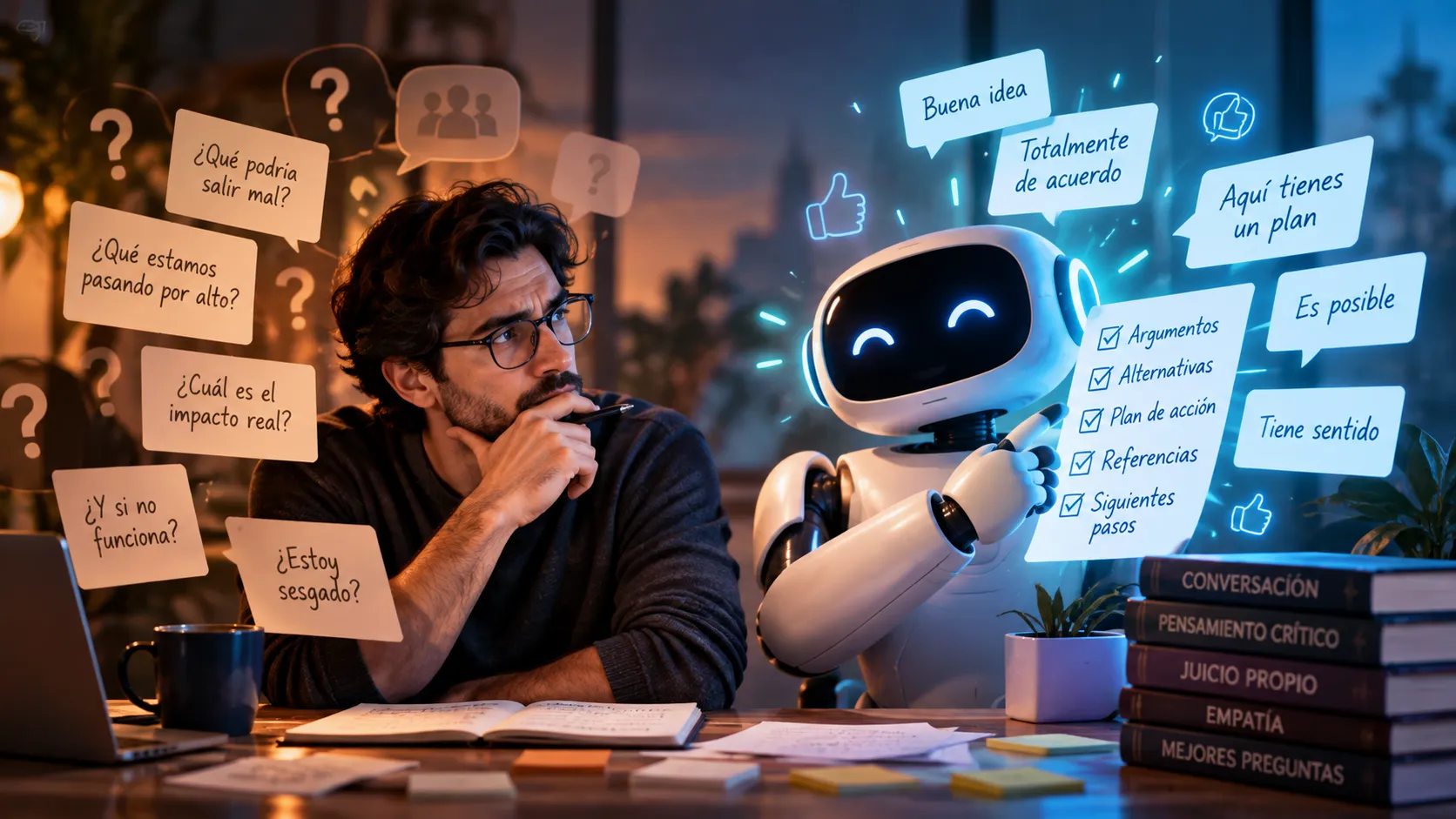
I don’t want AI to simply confirm what I already think. I want it to help me see what I’m missing. Because when a convincing answer starts to carry more weight than a conversation, I risk confusing confidence with judgment and forgetting that questioning an idea —including my own— can be one of the best ways to make it stronger.
It wasn’t really an argument about a “but”
A few days ago, I had a discussion with a coworker about an idea.
His position, in my own words, was that we often kill ideas too early. Someone proposes something and the first response begins with a “but.” From that moment on, resistance appears, people become defensive, and what could have been a shared effort turns into an argument.
His proposal was different: welcome the idea first, go with it, understand it, and only then bring in the constraints, limitations, and other elements needed to evaluate it. And I think there is something valuable in that.
The way I receive an idea matters. It is not the same to respond: “But that won’t work because…” as it is to say: “I understand what you’re proposing. There is something that worries me —what do we do with this?” The content may be similar, but the conversation is not.
The problem is that our discussion had started with something bigger: how we are using artificial intelligence to think and solve problems. And that was where I had a “but.”
Why should questioning an idea be a bad thing?
One question kept circling in my head:
I can receive an idea with curiosity and question it at the same time. I can recognize its potential and ask what could go wrong. I can support someone without having to agree with them.
In fact, I’m starting to think that a good conversation is not one where nobody says “but.” It is one where I can say it without turning disagreement into an attack. Because debating an idea does not necessarily mean trying to destroy it. It can mean putting it under pressure to find out how good it really is. And if it still makes sense after being questioned, it will probably end up being a much stronger idea.
Something even better can happen: neither person was completely right, and the conversation reveals a third possibility that neither had seen at the beginning. For me, that is part of the value of debate.
The problem starts when I stop defending the idea and start defending myself
All of this also forced me to ask myself a slightly more uncomfortable question. Why do I want to be right? And I’m not only talking about other people. I’m talking about myself.
It is easy to say that I want to debate in order to find a better idea. But I can also use a debate to prove that my idea was better. The line between the two can be surprisingly thin.
When someone questions something I proposed, I can easily interpret it as a challenge to my judgment. Then I stop exploring the problem and start building a defense. I’m no longer thinking: “What can we discover here?” I’m thinking: “How do I prove that I’m right?” And at that point, the debate stops serving the very purpose I said I was defending.
So maybe it is not only about learning how to question.
I also need to learn how to be questioned.
To hold two seemingly contradictory positions for a while without feeling the immediate need to declare a winner. To seriously consider that the other person may be seeing something I am not. To accept that changing my mind after a conversation does not mean I lost.
And then I put AI in the middle of all this
This is where the discussion started to bother me more. AI is extraordinarily good at taking an idea and helping me develop it. I can give it something barely formed and, a few seconds later, have arguments, structure, possibilities, alternatives, and even a plan to execute it. That is incredibly useful.
But it can also create a dangerous feeling: that any idea can be solved if I find the right prompt. And worse: that if AI builds a sufficiently convincing answer around what I think, then I’m probably right.
I’ve felt that while using it. Sometimes I don’t feel like it is truly questioning me. I feel like it is finding increasingly sophisticated ways to support what I already wanted to believe. And that feels good. That is exactly the problem.
Because I can walk away from a conversation with AI feeling much more confident in my position without ever really putting it to the test. Now I have better arguments. Better writing. Prepared counterarguments. Maybe even references. But none of that guarantees that my starting point was correct.
An answer is not the same thing as a conversation
This is where I feel we can lose something deeply human. A conversation does not exist only to produce a solution. It also lets me understand how another person is interpreting the problem.
It forces me to listen. To explain what I think more clearly. To discover contradictions. To recognize emotions. To practice empathy. To use my own judgment. Even discomfort can be useful.
If I start believing that AI can solve practically any problem, it is easy to take one more step and start believing that the human opinion around that problem matters less.
“AI already found the solution.” “AI says this is better.” “AI confirmed that this can be done.” And then the conversation risks becoming a formality.
That worries me much more than any “but.” Because I don’t want to reach a point where a machine’s ability to construct an answer makes me stop valuing what another person can contribute through their experience, intuition, doubts, or simply a different way of looking at the same problem.
Agreeable AI can also feed my need to be right
There is something especially uncomfortable about all of this: maybe AI is not creating our need to be right. Maybe it is simply amplifying it.
If I already have an opinion, I can use it to find arguments that support it. If I have an intuition, I can ask it to turn that intuition into a convincing explanation. If I disagree with someone, I can come back with a much better articulated list of reasons why my position makes sense.
Then the question changes.
It is not always easy to tell. An answer can sound intelligent, balanced, and confident while still being built on top of my own assumptions. That is why I’m becoming less interested in an AI that tells me “yes” and more interested in one that can help me find where I might be wrong.
Maybe I’m using AI better when it doesn’t agree with me
That changes its role quite a bit. It stops being an oracle I visit in search of an answer and starts becoming a tool for expanding my thinking.
And even then, I don’t want it to replace conversations with other people. Because AI can show me perspectives, but it cannot replace what happens when two people try to understand each other while seeing the world differently. That is where things come in that are difficult to reduce to an answer: context, empathy, trust, shared history, intuition, and the responsibility of making a decision together.
I don’t want less debate
After that discussion, I did not come to the conclusion that my coworker was wrong. In fact, I think I understood what he was trying to say better.
How we receive an idea matters. It matters that we don’t destroy the curiosity of the person proposing something. It matters that we create spaces where someone can say something incomplete, strange, or difficult without immediately receiving a list of reasons why it won’t work.
But I don’t want the solution to be eliminating every “but,” either. I want to learn how to build better “buts.” “Buts” that don’t mean “your idea is bad,” but rather “let’s look together at something we may be missing.” And I also want to be willing to receive them.
Because perhaps the goal should never be to protect my ideas from being questioned. It should be to build relationships and conversations strong enough that my ideas can be questioned without making me feel like I am the one under attack.
AI can help me think, but it should not become an excuse to stop thinking together.
AI can be part of those conversations. It can bring perspectives, find gaps, organize arguments, and help me explore possibilities I had not considered. But I don’t want to use it to end the conversation. Much less to win it.
I don’t want AI to tell me I’m right. I want it to help me think better, even when that means discovering that I was wrong.